
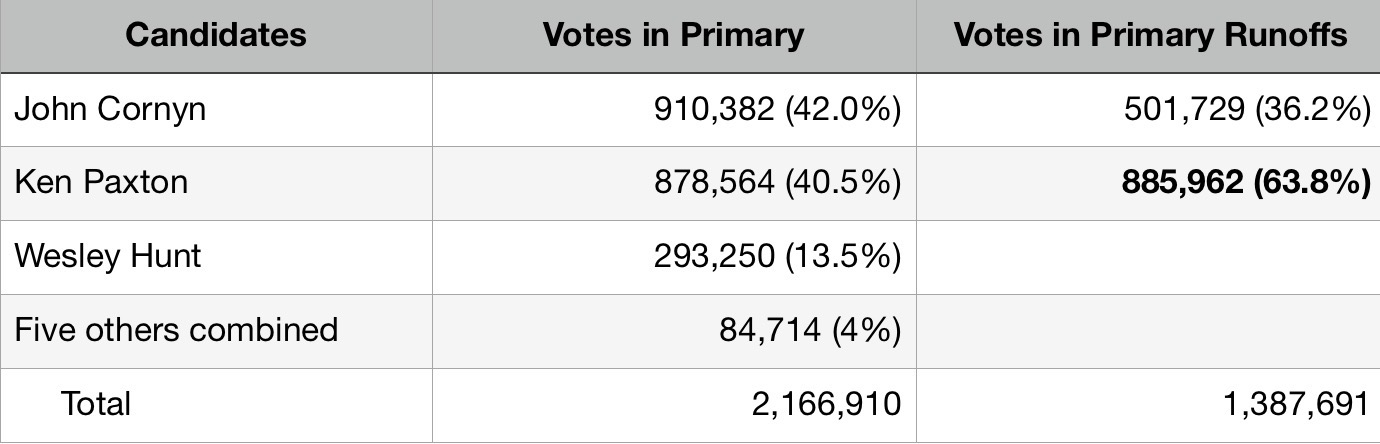
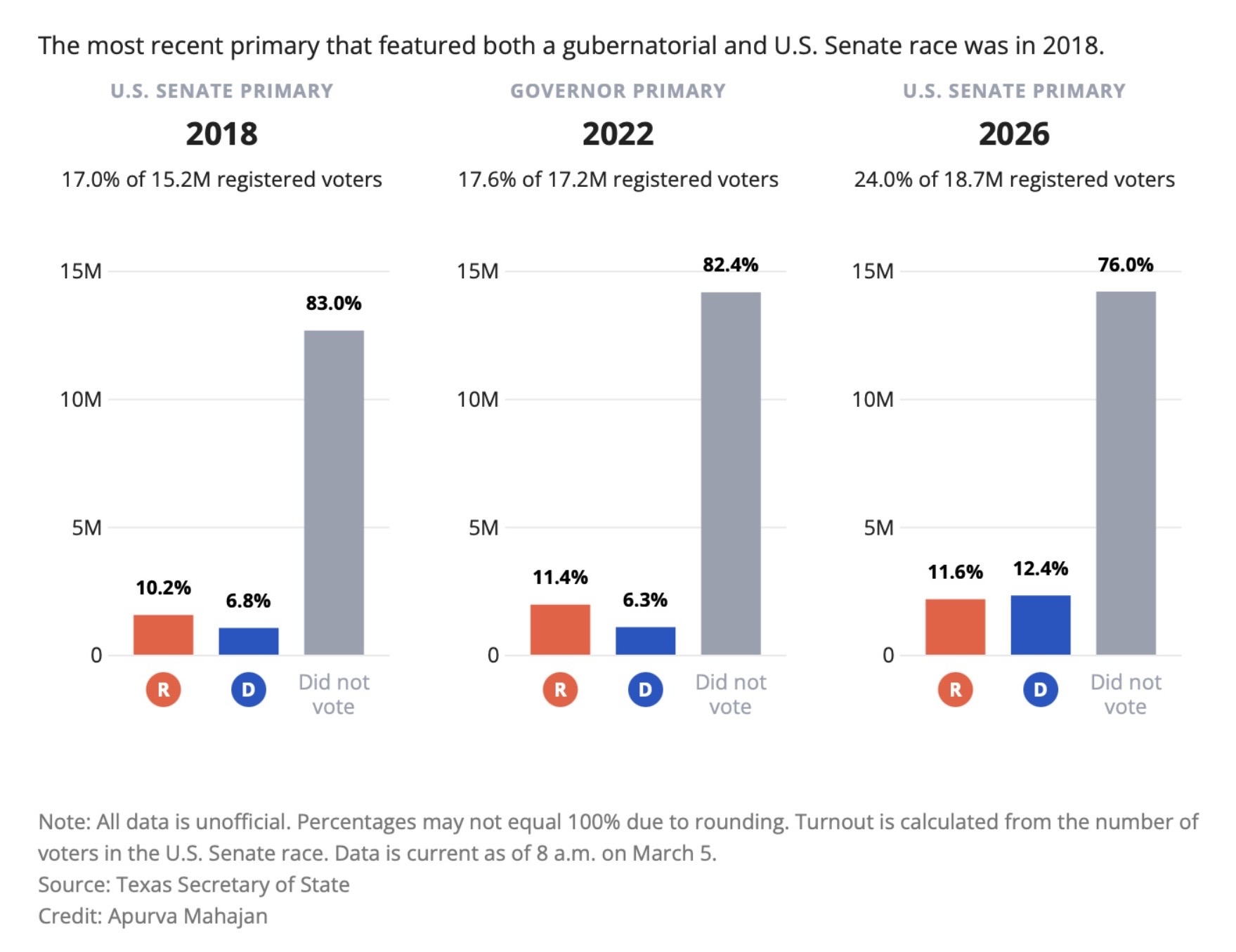
Texas Senate 2026 Primary Election and Runoff - Things to Know
What About the Costs of the Runoffs?
Video Explains Election Frustrations in Houston
RCV Myths EXPOSED
Find Your Voice!
What We're Reading
|
|
Texas Senate 2026 Primary Election and Runoff - Things to Know |
|
 |
|
 |
|
Many thanks to all of the Texas voters who let their voice be heard through their vote! More information about the May 2026 primary runoffs is available in this FairVote article. |
What About the Costs of the Runoffs? |
|
The runoff elections held in Texas on May 26 may have cost taxpayers as much as $23 million, which is similar to the costs of any other statewide election. What about costs for the candidates? The contentious runoff race between John Cornyn and Ken Paxton cost them $20 million, in addition to 12 weeks of their time and energies campaigning. Meanwhile James Talarico, who won his primary without a runoff, did not have to spend that extra money and had a three-month head start on the general election campaign. Implementing Instant Runoff Voting (IRV) could save Texas (and the candidates) millions by eliminating the need for separate runoff elections. |
Video Explains Election Frustrations in Houston |
|
Mary Beth Gilbert, a member of our Board of Directors, was part of a team who put together this video, which highlights the growing frustration in Harris County, Texas (which includes Houston) over the number and cost of local elections. It also explains how instant runoff voting can decrease the number of elections and hence the cost. |
RCV Myths EXPOSED |
|
In a paper titled "Shaky political "science" misses mark on ranked choice voting", the quality and credibility of scholarly research about ranked choice voting (RCV) is assessed. Forty-one studies are reviewed, many of which have been cited in public debates over RCV reforms. The authors found that studies grounded in real-world election data tended to be most reliable, while research critiquing RCV more often relied on survey methods and mathematical models - approaches they argue fail to capture actual electoral behavior. Because of its length, we are breaking it into separate studies and featuring them individually. The first study was described in April’s newsletter. The third category group of studies are ones based on real-world election results. Researchers Alan Parry and John Kidd of Utah Valley University analyzed two studies of RCV elections and showed how these studies have serious methodological and analytical flaws. One of these non-peer reviewed studies (number 27 below), by University of Pennsylvania researchers Stephen Pettigrew and Dylan Radley, broadly asserted that ranking candidates by order of preference increased ballot error rates, claiming that ballot marking errors increased ten times. Dr. Parry and Dr. Kidd found these claims to be baseless and largely out of context. In this category we find "Overvotes, Overranks, and Skips: Mismarked and Rejected Votes In Ranked Choice Voting" by Pettigrew and Radley. Previous to this study, other studies had indicated that ballot errors in RCV elections largely follow the same patterns as errors in non-RCV elections, with RCV marginally higher in some races. The Pettigrew-Radley findings claimed that one in twenty RCV ballots - 5% - were 'improperly marked' in some way. But an improperly marked ballot is not the same as making an error that invalidates that ballot, and "most likely indicate a political expression rather voter confusion," observed critics Parry and Kidd. In fact, Parry and Kidd found that 90% of those improperly marked ballots were actually counted as intended by the voter. "Claiming that one in twenty ballots were problematic exaggerates that the issue is over ten times larger than it actually is, and as such, is remarkably misleading," said Parry and Kidd. The overall average rejection rate for RCV elections was 0.53% compared to 0.04% for non-RCV elections. So the difference was 99.96% acceptance rate compared to 99.47%, both very high numbers for valid ballot rates. While the RCV error rates are indeed about ten times larger than non-RCV, ten times a very small number is still a very small number. For more information on this particular study or the complete paper, click on the links above in this article. |
Find Your Voice! |
IRV for Texas is Seeking a New Executive ChairOur current Executive Chair is stepping back in his role but will stay on as an active board member. It is a part-time, volunteer position. Instant Runoff Voting for Texas was begun in 2018 out of a desire to eliminate high cost, low turnout runoff elections, specifically in nonpartisan municipal elections, special elections, party primary elections and for military and overseas voters. Position responsibilities are attached here. We are looking for anyone who may be interested or who knows someone who may be interested in leading this organization. Please contact Joanne Richards for more information. |
We Need Social Media Volunteers!Social media provides the best way to get in touch with most voters and potential voters today. This is a resource we have barely tapped into and really need someone who is proficient here. Young voters are an untapped constituency and are plugged into all social media platforms. Help us get the word out about all things instant runoff voting.
If you are interested, please contact Mary Beth Gilbert.
If you are interested, please contact Mary Beth Gilbert. IRVforTexas Relies on Donations to Spread the Word about IRVThere are so many people who either haven't heard about IRV or have received misinformation about it. Reaching those people takes resources and time, but it is definitely something worth pursuing. Please consider making a one-time or recurring monthly donation to help ensure that our work to improve Texas elections can continue. |
|
What We're Reading
|
|
|

|
|
|
|
|


|
Instant Runoff Voting for Texas · TX, United States |